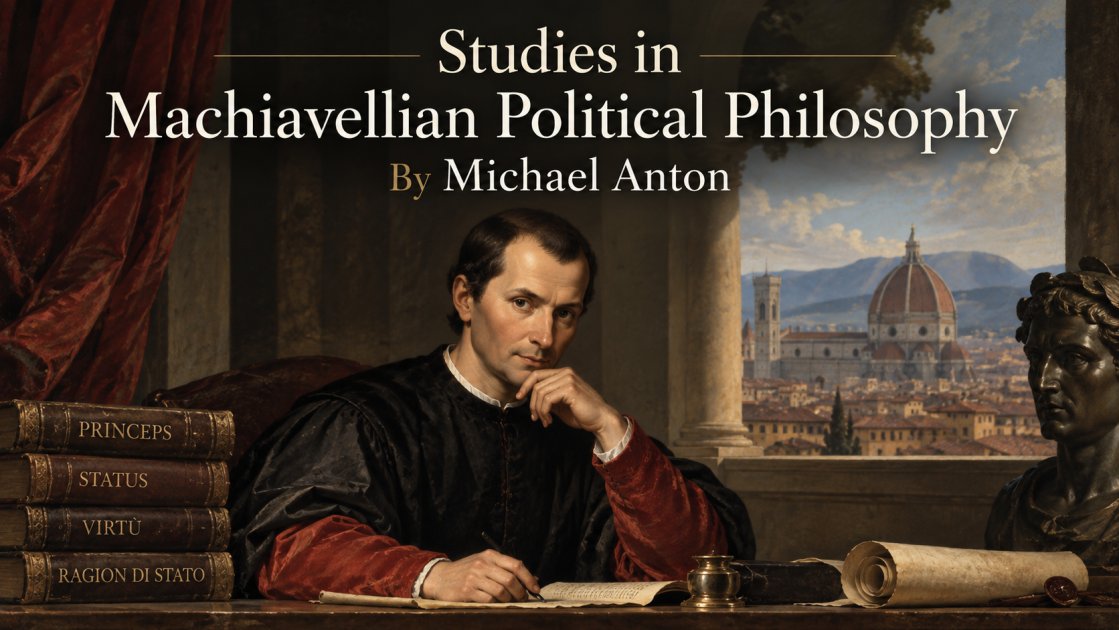
Michael Anton’s new book Studies in Machiavellian Political Philosophy argues that Machiavelli’s ideas shaped “a modernity antagonistic to Christianity,” and suggests that Christians should use Machiavellian tactics to counteract the philosopher’s objectives. Reviewer Casey Chalk asks if this clever tactic is actually a good one, and suggests looking to Machiavelli’s contemporary St. Thomas More as “an illuminating foil.”
Michael Anton’s book is especially relevant to scholars of natural law because it presents Machiavelli as marking one of the decisive moments in modern political philosophy’s break with the classical and Christian conception of an objective moral order. On Anton’s reading, Machiavelli does not merely propose more effective techniques for acquiring and preserving power; he deliberately narrows the horizon of politics, severing it from its subordination to human flourishing and a transcendent order, and replacing the primacy of virtue and justice with effectiveness, security, and glory. From the perspective of the natural law tradition, this transformation is fundamental, since it helps us understand historically the transition from a conception of politics—as found in Aristotle and Thomas Aquinas—as part of practical reason directed toward the common good, to a political rationality increasingly autonomous from morality. The contrast drawn in the book between Machiavelli and Thomas More is therefore particularly illuminating: against the maxim that political necessity may justify morally wrongful actions, More embodies the classical thesis that political prudence is genuine prudence only when it remains ordered to justice and the good. Studying Machiavelli from this perspective ultimately enables us to understand not only the intellectual origins of political modernity, but also what the natural law tradition seeks to preserve in response to it: the subordination of power to moral reason and of political action to the integral good of the human person and the community.
Click this link to read Casey Chalk's commentary on the work
SPANISH:
El libro de Michael Anton resulta especialmente relevante para los estudiosos de la ley natural porque presenta a Maquiavelo como uno de los momentos decisivos en la ruptura de la filosofía política moderna con la concepción clásica y cristiana de un orden moral objetivo. Según la interpretación de Anton, Maquiavelo no se limita a proponer técnicas más eficaces para conquistar y conservar el poder: reduce deliberadamente el horizonte de la política, prescindiendo de su subordinación al bien humano y a un orden trascendente, y sustituyendo la primacía de la virtud y de la justicia por la eficacia, la seguridad y la gloria. Desde la perspectiva de la tradición de la ley natural, esta transformación es fundamental, pues permite comprender históricamente el tránsito desde una política concebida —como en Aristóteles y Tomás de Aquino— como parte de la razón práctica orientada al bien común, hacia una razón política progresivamente autónoma respecto de la moral. El contraste que aparece en el libro entre Maquiavelo y Tomás Moro resulta, por ello, particularmente esclarecedor: frente a la máxima de que la necesidad política puede justificar acciones moralmente malas, Moro encarna la tesis clásica de que la prudencia política sólo es verdadera prudencia cuando permanece ordenada a la justicia y al bien. Estudiar a Maquiavelo desde esta perspectiva permite, en definitiva, comprender mejor no sólo los orígenes intelectuales de la modernidad política, sino también aquello que la tradición de la ley natural pretende preservar frente a ella: la subordinación del poder a la razón moral y de la acción política al bien integral de la persona y de la comunidad.
Leer en este enlace el comentario a la obra escrito por Casey Chalk