By Colin Redemer Published on 5 May 2026 in First Things.
[Traducción al español más abajo en esta misma página]
There is a particular kind of modern person who, upon encountering the messiness of human life, its sheer ungovernable profusion, and the suffering it entails, recoils not with pity or solidarity but with disgust. And because disgust is rarely accepted as its own justification, such a person dresses his disgust in the language of optimization, selection, species-level improvement—that is, eugenics. But if you listen carefully, he is not really saying, “Humanity could be better.” He is saying, “I cannot bear what I am".
This distinction matters enormously, and almost nobody is making it.
The old eugenics of Galton and his heirs, of Buck v. Bell (1927) and the Kaiser Wilhelm Institute, was many terrible things, but its terribleness was at least coherent. It believed, with the confidence peculiar to the late nineteenth century, that the human species was a stock to be managed, and that the managers were identifiable by their breeding, their cranial measurements, and their position in the social hierarchy. The eugenicist of 1910 looked out at the world and saw inferiors. He honored himself. He was monstrous, but he was monstrous in the direction of self-congratulation.
The new eugenics operates from an almost perfectly inverted posture. It does not look outward with contempt but inward with revulsion. When someone on the internet announces that it would be better if people with certain genetic predispositions—depression, obesity, chronic illness—simply did not reproduce, he is rarely talking about strangers. He is talking about himself. In nearly every case, he has been taught to see his own body, his own mind, his own inherited frailties as defects in need of correction or, better yet, elimination. He does not want to improve the race. He wants to be unmade.
A great deal of what circulates online as eugenic ideology is simply depression wearing a lab coat. It is self-loathing that has graduated from the personal to the philosophical, that has found a way to universalize its private verdict of worthlessness. If I should not exist, then surely others like me should not exist either. The conclusion may sound scientific, but the premise is despair.
You can see this pattern everywhere. The antinatalist forums, the “voluntary human extinction” communities, the casual talk of genetic screening as a moral obligation—these are not populated, in the main, by triumphant Nietzschean Übermenschen, but by people who are suffering and who have concluded that suffering is a design flaw rather than a feature of creaturely life. This is true whether the suffering is that of the cancer patient wishing for a cure or the subtler suffering of the expectant mother whose heart breaks thinking of her child (as in Mills’s poem above). They have been failed, not by their genes, but by a culture that sees their existence as requiring a cost-benefit analysis, rather than as a gift.
The Christian tradition has a name for this failure: the refusal of creatureliness. To be a creature is to be dependent, limited, mortal, and marked by the particularities of one’s birth. It is to have a body that breaks down, a mind that wanders, a will that falters. The whole arc of Scripture assumes that this is the condition into which grace arrives, not the condition from which we must engineer an escape. The Psalmist who cries out from the depths does not conclude that the depths should be abolished. He waits for the Lord.
But our civilization treats limitation as a scandal. From the productivity culture that measures human worth in output, to the therapeutic culture that treats every discomfort as a pathology, to the techno-utopian culture that promises transcendence through the machine, everywhere the message is the same: You should not have to suffer, and if you do, something has gone wrong. Not wrong in the moral sense, mind you, not wrong in the way that might call us to repentance or charity or patient endurance. Wrong in the engineering sense. A bug to be patched. A defect to be screened out in the next iteration.
When people marinate long enough in this logic, the step from “my suffering is a defect” to “I am a defect” is vanishingly small. And from there, the step to “people like me are defects” is smaller still. Eugenics becomes, paradoxically, a form of self-harm like a young woman who cuts herself to feel better, however briefly. But this cutting happens at the level of the soul rather than the skin.
This is why arguing against neo-eugenics on purely scientific grounds is necessary but insufficient. You can win every empirical argument and still lose the person, because the person was never really making an empirical argument. He was crying for help in the only dialect his culture gave him—the dialect of data, of studies, of rational self-improvement. He needs to hear something that no genetically optimized biohacking program can tell him, which is that he is not a problem to be solved.
The proper answer to the new eugenics is not, in the first instance, a policy argument or a bioethics seminar. It is an anthropology—a true account of what a human being is. And what a human being is, according to the oldest and most enduring witness of the Western tradition, is a creature made in the image of God, broken by sin, and offered restoration not through the elimination of weakness but through its transfiguration. “My grace is sufficient for you,” Paul hears, “for my power is made perfect in weakness.” This is the farthest thing from a platitude. It is a metaphysical claim about the structure of reality, and it is directly and irreconcilably opposed to the self-hatred of the new eugenics.
We will not talk people out of eugenics by proving it unscientific, though it is. We will talk them out of it by convincing them—slowly, patiently, probably over meals and in the context of churches whose members actually bear one another’s burdens—that they are not mistakes. That their neediness is not a flaw but an invitation to become whole in a way they cannot currently imagine. “There is a crack in everything,” as Leonard Cohen sings, “That’s how the light gets in.” The world in pain must hear the word of hope: There is a meaning to your suffering.
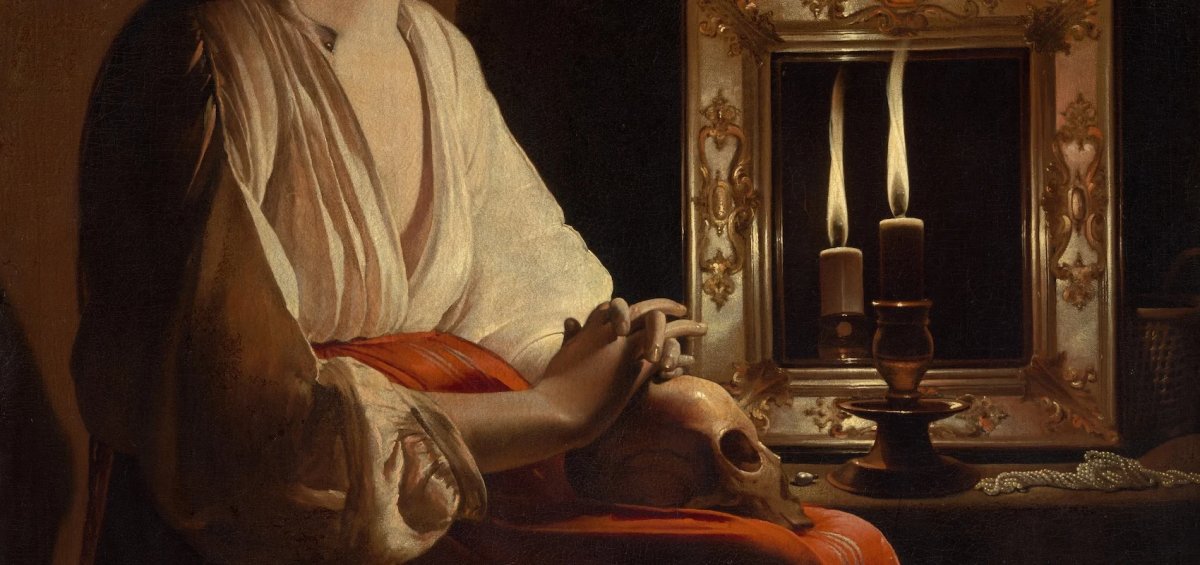
The eugenicist who hates himself needs a better mirror. One that reflects not defects to be edited, but a person to be loved.
For further reading: In 2019, First Things published an excerpt from Clarence Thomas’s concurring opinions in Box v. Planned Parenthood of Indiana and Kentucky: “Abortion and Eugenics.” Justice Thomas focuses his polemic on the original eugenics movement.
/////////////////////
Español:
Hoy en día hay un tipo de persona que, al enfrentarse a la dureza de la vida, a su complejidad incontrolable y al sufrimiento que conlleva, retrocede no con compasión o solidaridad, sino con repugnancia. Y como el asco rara vez se acepta como justificación en sí mismo, esa persona disfraza su asco con el lenguaje de la optimización, la selección y la mejora a nivel de especie; es decir, la eugenesia. Pero si se escucha con atención, en realidad no está diciendo: «La humanidad podría ser mejor». Lo que está diciendo es: «No puedo soportar lo que soy».
Esta distinción es de enorme importancia, y casi nadie la está haciendo.
La antigua eugenesia de Galton y sus herederos, de Buck contra Bell (1927) y del Instituto Kaiser Guillermo era horrible, pero su horror era al menos coherente. Creía, con la confianza propia de finales del siglo XIX, que la especie humana era una raza que debía controlarse, y que los modelos eran identificables por su genealogía, sus medidas craneales y su posición en la jerarquía social. El eugenista de 1910 miraba al mundo y veía a los inferiores. Se honraba a sí mismo. Era monstruoso, pero lo era en el sentido de la autocomplacencia.
La nueva eugenesia opera desde una postura invertida. No mira hacia fuera con desprecio, sino hacia dentro con repulsión. Cuando alguien en Internet anuncia que sería mejor que las personas con ciertas predisposiciones genéticas —depresión, obesidad, enfermedades crónicas— no se reprodujeran, rara vez se refiere a extraños. Se refiere a sí mismo. En casi todos los casos, se le ha enseñado a ver su propio cuerpo, su propia mente, sus propias debilidades heredadas como defectos que necesitan corrección o, mejor aún, eliminación. No quiere mejorar la raza. Quiere deshacerse de sí mismo.
Gran parte de la ideología eugenésica de nuestro tiempo no es más que depresión disfrazada con bata de laboratorio. Es el odio hacia uno mismo que ha pasado de lo personal a lo filosófico, que ha encontrado la manera de universalizar su veredicto sobre la propia inutilidad. Si yo no debería existir, entonces seguramente otros como yo tampoco deberían existir. La conclusión puede parecer científica, pero la premisa no es científica, sino la propia desesperación.
Este patrón se puede ver en todas partes. Los foros antinatalistas, las comunidades de la «extinción humana voluntaria», las conversaciones informales sobre el cribado genético como obligación moral: tales foros no están llenos, en su mayoría, de triunfalistas Übermenschen nietzscheanos, sino por personas que sufren y que han llegado a la conclusión de que el sufrimiento es un defecto de diseño, más que una característica de la vida de las criaturas. Esto es cierto tanto si el sufrimiento es el de un paciente de cáncer que desea una cura, como el más sutil de una futura madre cuyo corazón se rompe al pensar en su hijo. Les ha fallado, no sus genes, sino una cultura que considera que su existencia requiere un análisis de coste-beneficio, en lugar de un regalo.
La tradición cristiana tiene un nombre para este fracaso: el rechazo de la condición de criatura. Ser una criatura es ser dependiente, limitado, mortal y marcado por las particularidades del propio nacimiento. Es tener un cuerpo que se deteriora, una mente que desbarra, una voluntad que vacila. Todo el contenido de las Escrituras asume que esta es la condición en la que llega la gracia, no la condición de la que debemos idear una vía de escape. El salmista que clama desde las profundidades no concluye que las profundidades deban ser abolidas. Él espera al Señor.
Pero nuestra civilización trata la limitación como un escándalo. Desde la cultura de la productividad que mide el valor humano en términos de rendimiento, pasando por la cultura terapéutica que trata cada malestar como una patología, hasta la cultura tecno-utópica que promete la trascendencia a través de la máquina, en todas partes el mensaje es el mismo: No deberías tener que sufrir, y si lo haces, algo ha salido mal. No mal en el sentido moral, ojo, no mal en el sentido que podría llamarnos al arrepentimiento, a la caridad o a la paciencia. Mal en el sentido de la ingeniería. Un error que hay que corregir. Un defecto que hay que eliminar en la próxima versión.
Cuando las personas se empapan de esta lógica, el paso de «mi sufrimiento es un defecto» a «yo soy un defecto» es minúsculo. Y de ahí, el paso a «las personas como yo son defectos» es aún más pequeño. La eugenesia se convierte, paradójicamente, en una forma de autolesión, como una joven que se lesiona a sí misma para sentirse mejor, aunque sea por un instante. Pero este corte se produce a nivel del alma, más que de la piel.
Por eso es necesario, aunque insuficiente, argumentar contra la neo-eugenesia basándose en motivos puramente científicos. Puedes ganar todos los argumentos empíricos y aun así perder a la persona, porque la persona nunca estuvo realmente planteando un argumento empírico. Estaba pidiendo ayuda en el único lenguaje que su cultura le proporcionó: el lenguaje de los datos, de los estudios, de la superación personal racional. Necesita oír algo que ningún programa de biohacking genéticamente optimizado puede decirle, y es que él no es un problema que haya que resolver.
La respuesta adecuada a la nueva eugenesia no es, en primera instancia, un argumento político ni un seminario de bioética. Es una antropología: un relato veraz de lo que es un ser humano. Y lo que es un ser humano, según el testimonio más antiguo y perdurable de la tradición occidental, es una criatura hecha a imagen de Dios, quebrantada por el pecado, a la que se le ofrece la restauración no mediante la eliminación de la debilidad, sino a través de su transfiguración. «Mi gracia te basta», oye Pablo, «porque mi poder se perfecciona en la debilidad». Esto es lo más alejado de un lugar común. Es una afirmación metafísica sobre la estructura de la realidad, y se opone directa e irreconciliablemente al odio hacia uno mismo de la nueva eugenesia.
No convenceremos a la gente de que renuncie a la eugenesia demostrando que no es científica, aunque lo sea. Les convenceremos de que la abandonen demostrándoles —lentamente, con paciencia, probablemente durante las comidas y en el contexto de iglesias cuyos miembros realmente llevan las cargas los unos de los otros— que no son un error. Que su necesidad no es un defecto, sino una invitación a alcanzar la plenitud de una forma que actualmente no pueden imaginar. «Hay una grieta en todo», como canta Leonard Cohen, «así es como entra la luz». El mundo que sufre debe escuchar la palabra de esperanza: tu sufrimiento tiene un sentido.
El eugenista que se odia a sí mismo necesita un espejo mejor. Uno que no refleje defectos que hay que corregir, sino una persona a la que amar.
Trad. revisada por Diego Poole
For further reading: In 2019, First Things published an excerpt from Clarence Thomas’s concurring opinions in Box v. Planned Parenthood of Indiana and Kentucky: “Abortion and Eugenics.” Justice Thomas focuses his polemic on the original eugenics movement.