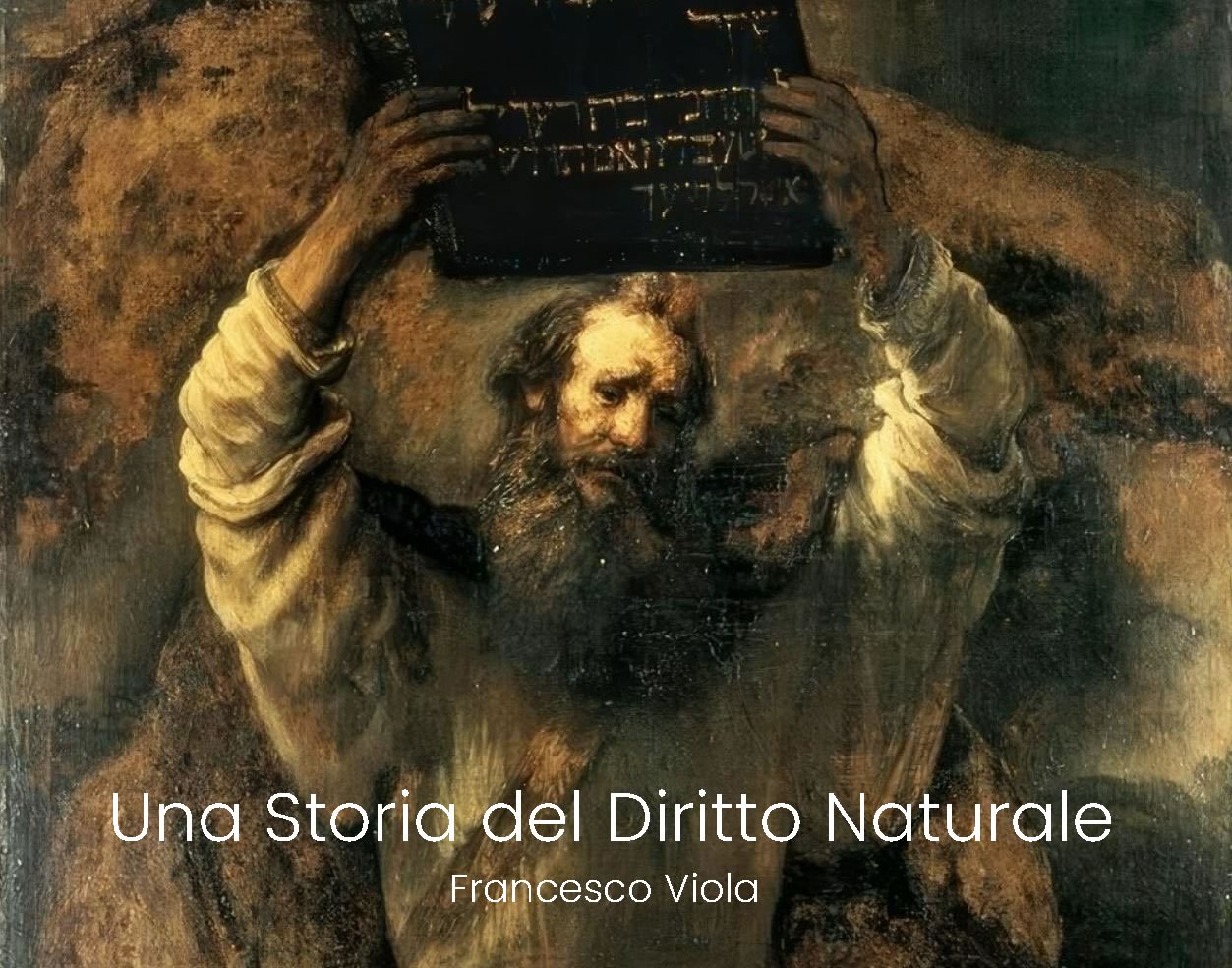
Viola, Francesco. 1900-2020. Una storia del diritto naturale. Torino, 2021, G. Giappichelli, 2021. 186p.
You can download the full book in ePub format by clicking this link.
.
Francesco Viola, professor emeritus of Philosophy of Law at the University of Palermo, has published this brief history of natural law over the last 120 years. It is a highly concise work, the result of many years of research, which offers a mature, calm, and thought-provoking reading of the notion of natural law, which was at the heart of the work of the vast majority of legal philosophers until the 18th century.
Firstly, he considers that natural law, as a theory of law, is characterized by the following features: "1) a description of law in light of its practical sense, that is, as a reason for action; 2) the importance of human nature for the purposes of determining the content of law; 3) the principle of evaluativeness of legal theory and, at the same time, its cognitive character; 4) the necessary connection between law and morality; 5) the legal character of natural law" (p. 2). He emphasizes that doctrines that proclaim themselves to be natural law comply with these features to a greater or lesser extent, so that there could be a stronger or weaker natural law.
Having established the above, the historical narrative begins. The starting point of the book is 1900, when criticism of Catholic and Reformed doctrines of natural law had almost completely taken over law schools, which had almost entirely succumbed to positivism. Viola, however, considers that this progressive expulsion of natural law led to a dialectical movement. In fact, during the 20th century, there were three revivals of natural law, always in combat with an overly narrow positivism. In all three revivals, Viola emphasizes the fundamental role of the philosophy of St. Thomas, rethought from very different angles.
Indeed, the first chapter explains the first revival, which took place during the first third of the century, in which we find the restoration of Catholic natural law, which arbitrated between the legal formalism and anti-formalism that flourished at that time. The basis of Catholic natural law was theism, metaphysical foundation, objective ethics and ethical cognitivism, the teleological derivation of the precepts of natural law, the universality and immutability of natural law, and the axiological conformity of positive law to natural law (p. 14). The author contrasts, among others, the readings of Cathrein with those of Stammler, Radbruch, Del Vecchio, Ehrlich... and presents the reaction of Maurice Hauriou's positivist neo-Thomism, as well as the ideas of Renard, Geny, Kantorowicz, Heck, and others.
The second chapter explains totalitarian natural law. For Viola, the neo-idealist philosophy of Italian fascism was contrary to both Catholic metaphysics and modern natural law, while the notion of natural law was widely used in Nazi propaganda (p. 58). This, however, despite its name, transgressed the fundamental principles of natural law established until then.
All of this led, after the end of World War II, to the second renaissance, which is explained in the third chapter. The horrors of war led various authors to vindicate common values and the link between axiology and natural law. The work of Maritain and Kalinowski had a strong impact before and after the Second Vatican Council. From the sources of St. Thomas, a non-scholastic natural law theory emerged, and even a non-Catholic natural law theory designed to permeate the secular world. Hence the natural law theory of the nature of the thing, based on legal experience (Capograssi), personalism (Maihofer), the ontological structure of law (Kaufmann), or the priority of the specific case (Villey).
The criticisms of Hart and other authors gave rise to the third renaissance, linked to the rehabilitation of practical philosophy, which is explained in the fourth chapter. In the last third of the 20th century, hermeneutics and legal argumentation sought to bridge the gap between legal positivism and natural law. New approaches emerged, such as constitutionalism or what Viola calls the “la terza teoria del diritto” (p. 107), initiated by Dworkin. From the debates between these currents, Christian natural law and exclusionary positivism, an interesting link emerged between natural law and what the author aptly calls “non-positivism” (p. 111). Indeed, within the framework of positivism, which does not reject any kind of relationship with morality, there is a wide range of doctrines that, without directly embracing the postulates of natural law, converge with natural law theory on some points. Some of the postulates of “non-positivism” would be, in the author's view, the claim to correctness (Alexy), the reasons for the binding nature of law (Nino or Atienza), or even a natural law theory of positive law, as defended by Fuller.
In Viola's words, “il non-positivismo ha messo in luce alcuni punti critici del giuspositivismo, legittimando il terzo ritorno del diritto naturale nella forma di una ricerca del diritto giusto interna alla determinazione del diritto positivo e elemento costitutivo della sua positività” (p. 119). For the author, non-positivism presents three ways of understanding the connection between law and morality: 1) that of integration, whereby law is distinguished from morality by the requirement to give effect to practical discourse; 2) that of the inclusion of law in social morality, which underpins its binding nature; and 3) that of the (total or partial) absorption of morality into law, which assumes an internal ethical value. The three orientations approach natural law in different ways, although they are not so in the full sense (p. 122).
The author adds a fifth chapter, dedicated to the first twenty years of the 21st century, which, unlike the previous ones, is completely unpublished. Viola explains the theses of the main authors of Catholic natural law, once again rooted in the work of St. Thomas, with important differences between them (McInerny, Finnis, George, Murphy...), from which new theories of natural law emerge, with a marked epistemological emphasis, which understand law as a rational standard of conduct (p. 132). They are politically situated between communitarianism and liberal relativism, as they justify the community on the basis of the rights of individuals and consider the exercise of their freedom within the framework of fundamental goods (p. 144).
As the author points out, "all'interno del nuovo giusnaturalismo, si presentano due linee di pensiero: quella volta a qualificare l'autorità e quella volta a sottodeterminarne il ruolo. The first orientation seeks to justify the legitimacy of authority on the basis of the good that it actually produces, which is to ensure social coordination, receiving the consent of citizens and giving rise to a system of legally binding rules. The second orientation does not believe that the fact that a norm belongs to the law of a political community means that it is authentically relevant to the determination of the common good, that is, it does not believe that mere legal validity presumptively contains an element of justice" (p. 145).
In recent years, other natural law doctrines have emerged, with an ontological and ideal orientation, respectively, which have not yet reached the same level of development as those of an epistemological nature. Viola, following Rodríguez Blanco, concludes that “the new theories of natural law are clearly distinguished from those originating in neo-scholasticism, in that they do not take their cue from human nature, but from practical reason, the use of which, however, is still governed by a specific conception of the nature of human action” (p. 161). Some of the features of neo-Thomist natural law have disappeared, and a postmodern law has even emerged, based on a new anthropology. In any case, just as "these new theories of natural law admit the possibility of a separation between the validity and justice of the law, and now inclusive legal positivism admits the possibility of a connection between law and morality, albeit contingent, the conflict has shifted to the issue of the relationship between law and practical reason, to the justification of the binding nature of law and its role within a theory of law" (p. 161). Therefore, according to the author, the current debate between natural law and legal positivism focuses on how to understand the concept and theory of positive law.
Francisco Viola's book, despite its brevity, is very important because it allows for a retrospective reflection that extends to the present day. His categories, although they may be debatable (as is especially the case with everything we lack perspective on), are very useful and enlightening. If it is already very difficult to explain the history of the 20th century in an orderly manner, the chapter on the first ventennio of our century is all the more meritorious.
The work takes a dialectical stance with the principles of neo-Thomism, a basis from which many stray, but to which not a few return. The core of the new theories of natural law lies, to a certain extent, in a secularization of Thomistic principles, so that they can be accepted by the “non-positivists,” who are legion today. At the same time, “non-positivists” seek a solid foundation for their principles and do not hesitate to draw on Thomism (Tomasian, in this case, rather than neo-Thomist) for some of their foundations, although without taking any supernatural elements.
This book by Viola, despite some minor errors (such as, for example, considering Germain Grisez a Franciscan theologian, p. 133), is very thought-provoking and deserves to be translated into Spanish and other languages. For now, we highly recommend reading it.