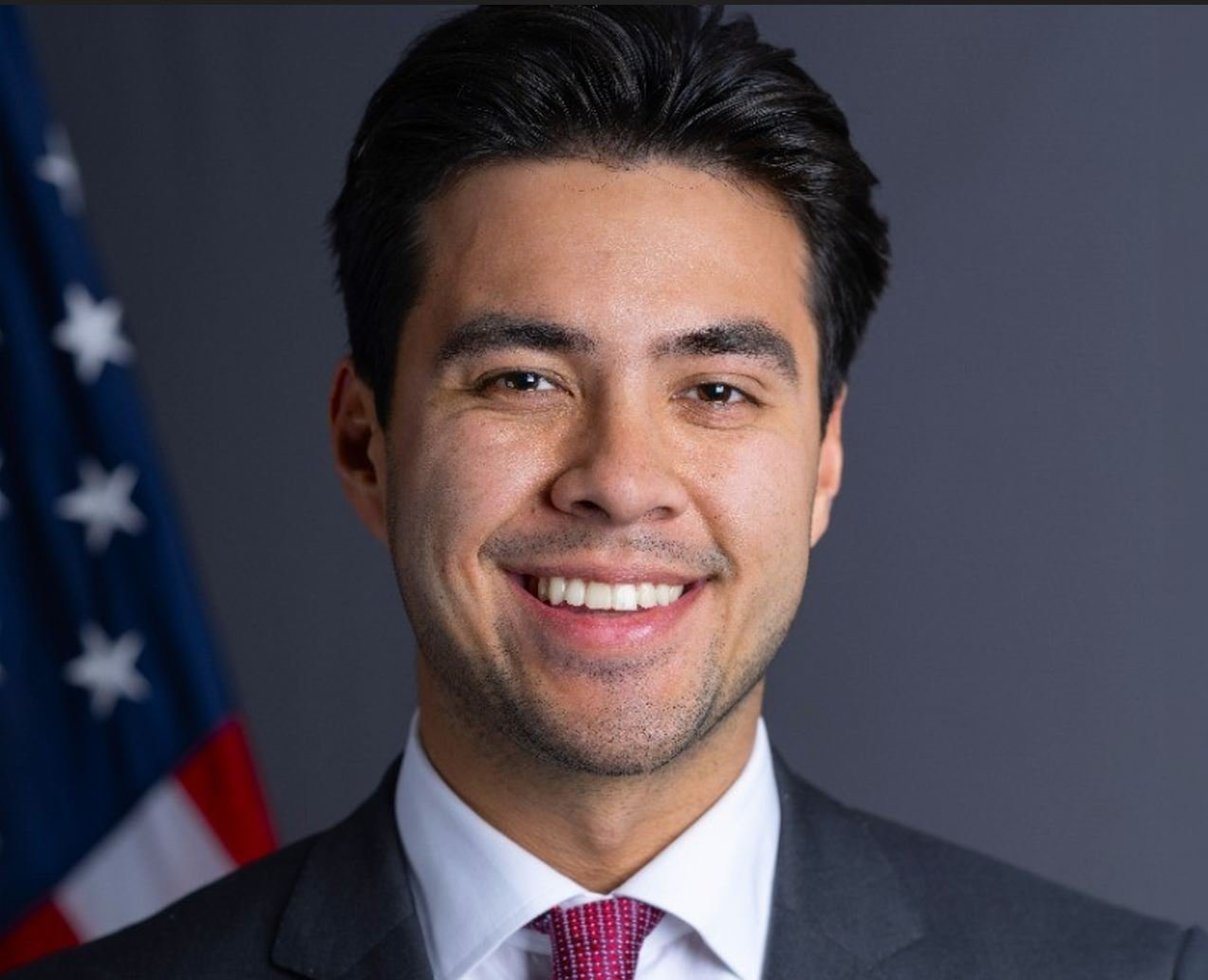
Samuel D. Samson
Senior Policy Advisor, U.S. Department of State
Lecture at the Hungarian Institute for International Affairs, Budapest, Hungary, December 15, 2025 (see also here)
Thank you. Fellow panelists and friends of America here in Hungary, good evening.
It is fitting that we gather in Budapest—a city that has endured tyranny and foreign occupation yet stands today as a living testament to the resilience of the Hungarian people.
Over the centuries Hungarians have bravely defended their freedom from external threats – Mongols, Ottomans, Nazis, and Soviets who repeatedly sought to conquer their people, erase their faith, and alter their identity.
In the aftermath of the First World War, Hungary resisted Bela Kun’s efforts to impose a Bolshevik regime through blood. After World War II, Hungarian patriotism proved too formidable an adversary for a direct assault. Even with the might of the Red Army, the Communists were reduced to utilizing censorship and social stigmatization to isolate opponents.
Those same tactics are now being employed by a sprawling regulatory apparatus that cloaks repression under the guise of “progress” and “public safety.” Across the European continent, governments, activist NGOs, and supranational bodies increasingly wield technology, courts, and political institutions to restrict patriotic voices, erode national sovereignty, and enforce rigid ideological conformity.
In Finland, a sitting member of parliament has faced multiple criminal charges for simply tweeting a Bible verse. In France, presidential candidate Marine Le Pen was summarily banned from running for President, despite leading in the polls. In Germany, the popular AfD party has been labeled a “right-wing extremist” group, paving the way for their disqualification. Across the continent, from Poland, to Romania, to Turkey, political figures are being barred from a fair electoral process through technical disqualifications.
As Vice President Vance warned in Munich earlier this year, the greatest danger to the West and Europe has become “…the threat from within—the retreat of Europe from some of its most fundamental values.”
The EU’s Digital Services Act and other regulations codify censorship, empowering “trusted flaggers” and radical leftist NGOs with sweeping de facto authority to suppress unwanted speech. Under the DSA, the European Commission just fined X 120 million euros on so-called “transparency violations” in an egregious attempt of extraterritorial censorship.
The EU threatens its sovereign members with legal retaliation if they resist enforcing their bureaucratic standards. Ireland, for example, faces lawsuits for its rightful hesitation to comply with Brussels’ speech directives. Hungary, of course, is no stranger to such coercive pressure, as seen most recently through its admirable resistance to the EU’s Migration and Asylum pact.
In the face of these assaults, Hungary has held firm, preserving its heritage, protecting its communities, and safeguarding its way of life. Sadly, the same cannot be said for Europe as a whole.
Mass migration has become rampant, with borders violated, citizens displaced from their homes, and local populations increasingly victimized by sexual assault, human trafficking, and other human rights abuses. Thousands of women and girls have been victimized by migrant grooming gangs in the United Kingdom alone.
Clearly, this is not a Europe of free speech and self-governance. Increasingly, this is a Europe destabilized by mass migration, where bureaucratic institutions are weaponized to stifle disfavored views, and legal systems are used to silence political opponents. Make no mistake: this jeopardizes civil stability and weakens the foundations of our transatlantic alliance. And this is why the Trump Administration is sounding the alarm to our friends in Europe.
America and Europe are not merely political partners—we are partners in civilization. This civilization was forged over millennia, shaped by a shared culture, a common moral inheritance, and unique bonds of affection. These are not abstractions. They are the living soil from which our freedoms, our duties, and our mutual commitments have grown. It is our shared Western civilization—not simply praxis or utility—that commands our loyalty and demands our defense.
In my time at the State Department, some have asked me to define “Western civilization” more precisely. Who belongs? What are its boundaries?
This intellectual parsing of what constitutes “the West” is, I believe, not the right question. The West is not a laboratory experiment to be endlessly dissected and reclassified. It is a particular people, a particular civilization—one you know when you see it, when you experience it, when you belong to it. This intuitive recognition is not a flaw; it is a strength.
The more urgent question is: Why is Western civilization worth defending?
Let me offer three answers.
First, at the most basic level, the West does indeed represent a vital strategic and economic alliance. Our nations share essential interests that must be defended in a world of growing hostility—especially from rising authoritarian powers, and above all, an ascendant China that stands in direct opposition to the West and its values. Central to this are deep commercial ties, industrial cooperation, and shared capacity for innovation and productivity. The West is not just a market to be sold to the highest bidder—those who care for it know that it must be a fortress of independence, strength, and capability.
The twentieth century vividly illustrates this point. As our State Department Counselor Mike Needham highlighted at this year’s Reindustrialize Summit, the Allied victory in World War II was only possible because of an unmatched capacity for industrial mobilization. Factories in the United States and Allied Europe produced arms, technology, and supplies at unprecedented scale and speed.
That capacity was no fluke—it was a civilizational advantage, achieved because of who we are and what we believe. It remains one of our greatest assets when facing today’s challenges. On this front, the commitment of NATO members to hit their spending targets is a welcome and encouraging advancement.
A second, more fundamental reason belies the first: proximity. The Ordo Amoris—the order of love—must guide how we think about alliances too.
America and Europe share a deep cultural and familial kinship. From classical philosophy to Christian theology, our legal and political traditions draw from the same source. Great European and American thinkers alike shaped our understanding of natural law, ordered liberty, and human dignity. Many of our citizens share bonds of marriage and family. The United States is, in every meaningful sense, culturally and historically closer to Europe than to any other region on Earth.
This reflects a basic truth of human nature: we have a moral obligation to protect and preserve what is closest to us.
A symbol of this proximity is on display in the Hungarian Parliament Building. The Holy Crown with which Pope Sylvester blessed King Stephen on Christmas day has resided there for over a millennium.
Yet in 1945, in the face of the advancing Red Army, a Hungarian Colonel handed the crown over to an American counterpart. He understood no matter what happened in the days ahead, this symbol of faith and nation would be safe in America. The Crown was kept secure at Fort Knox, until the day it could be returned to the Hungarian people, and symbolize their freedom once again.
Third, and most fundamentally, the West is worth defending because of its great anthropology—not just abstract ideas, but its people, culture, faith, and ultimately, its recognition of the Truth itself that has fostered mankind’s understanding of human nature and human flourishing.
It begins with the wisdom of antiquity. Aristotle taught that man is a political being, and that virtue—acting according to our nature—leads to eudaemonia, the good life. Cicero and the Roman tradition emphasized civic duty and national identity—the strong city as essential to living well. Christianity fully revealed man’s ultimate nature: being made in the Imago Dei, the image and likeness of God.
Saint Thomas Aquinas synthesized these realities, grounding natural law in divine reason, and rooting political life and duties within moral order. The Magna Carta enshrined the principle of this law above rulers. And the spirit of the West: Homer’s epics, Constantine’s conversion, Columbus’s voyages, Thomas More’s martyrdom, Beethoven’s symphonies, Washington’s crossing of the Delaware, Lewis and Clark’s westward expedition, Armstrong’s “one small step” on the moon—all reflect this moral and intellectual fortitude, each a manifestation of the great civilization that we should all be proud of.
And at the heart of Western civilization lies this central truth: that man is a rational, free, and moral being—with rights grounded not in the shifting will of the state, but in nature and in God. It is from this truth that our greatest achievements flow.
I believe that America is one of the crowning jewels of this tradition. The Declaration of Independence’s famous words that we are “endowed by our Creator with certain unalienable rights” echo Aristotle, Aquinas, and other great Europeans who recognized all men are born with natural rights that no government can deny.
But we also must remember that Western civilization is not something that can be uprooted and replanted anywhere in the world. The West is not a school curriculum – it is an embodied reality: a people with a clear-eyed vision of who man is and what he is made for.
It is this civilizational confidence that today’s globalist worldview rejects. It disdains the West and the truths it recognizes—its people, its virtues, its history, and its essential understanding of the human person. A new progressive theology condemns tradition as unnecessary. Religious faith is dismissed as antiquated. Human rights are conformed to ideological agendas. Migration-related abuses are covered up. Family life is labeled oppressive. Patriotism is branded racist or extremist. It demands shedding a “colonialist past” to reach an “end of history” without borders, morals, and economic limitations.
Those who question this new orthodoxy are labeled threats to democracy and silenced. The United States and President Trump, like Hungary, Poland, Czechia, Slovakia, and other freedom-loving nations in Europe, are no strangers to these types of slanderous attacks.
This silencing is more than political censorship—it stifles the West’s adventurous spirit and attacks the very foundations of civil society. When truth is deemed offensive, patriotism labeled extremism, faith dismissed as foolish, and rights reduced to identity politics, what is at risk is not merely public policy—but civilization itself.
To defend the West is to embrace its heritage with pride—as a blessing and a light amid what Pope Benedict XVI called the “dictatorship of relativism.” We therefore must pursue a robust defense of our culture, history, religion, borders, and ultimately, the West’s unique anthropology: the truth of man’s rational, social nature—the Imago Dei—and so too of natural rights.
In that spirit, the State Department’s new Office of Natural Rights is a major advance. By rejecting novel and ideological ideas that have grown out of a positivist approach to human rights, it returns America to its Western roots—to the goods of virtue, freedom, and objective truth upon which our society depends. This office will engage in targeted action to resist traditional authoritarians and modern ideologues alike who seek to undermine these core societal goods. This is part of President Trump and Secretary Rubio’s vital recommitment to a diplomacy that unapologetically champions American values, deliberately pursues America’s national interest, and diligently works alongside those allies who share those enduring values and interests.
In this common civilizational struggle, we must never lose sight of the fact that our nations, and the traditions we represent, are greater than any single individual, party, or election. Institutions and leaders must do more than tolerate the West’s virtues—they must hold themselves and those who lead them to the same standard.
As President Trump mentioned during Prime Minister Orban’s visit to Washington last month, Hungary should be applauded for its noble efforts on this front. Indeed, to quote our President, “this is a golden age for U.S.-Hungary relations.”
And as we move forward together, you can all be assured that the Trump Administration, and the American people, stand alongside you as civilizational allies.
The work ahead is immense—but so too is the legacy we inherit. By rediscovering, defending, and promoting the goods of our common culture, we can ensure that Western civilization remains a living and powerful blessing for generations to come.
Thank you.