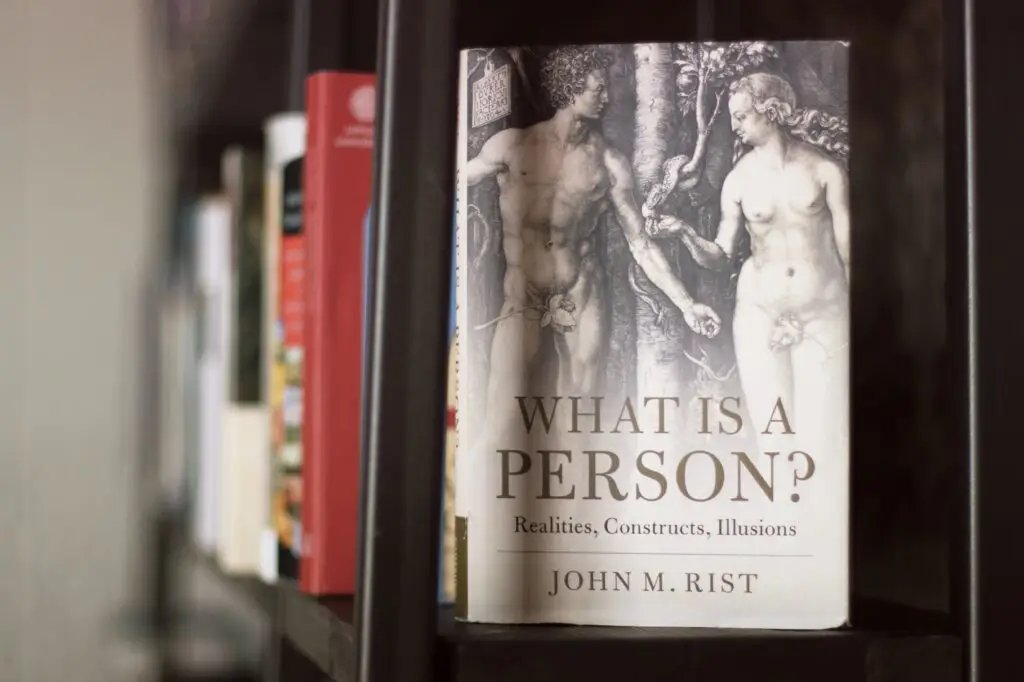
Rist, J. M. (2020). What Is a Person? Realities, Constructs, Illusions. Cambridge University Press.
In this book, John M. Rist offers an account of the concept of 'person' as it has developed in the West, and how it has become alien in a post-Christian culture. He begins by identifying the 'mainline tradition' about persons as it evolved from the time of Plato to the High Middle Ages, then turns to successive attacks on it in the seventeenth and eighteenth centuries, then proceeds to the 'five ways' in which the tradition was savaged or distorted in the nineteenth century and beyond. He concludes by considering whether ideas from contemporary philosophical movements, those that combine a closer analysis of human nature with a more traditional metaphysical background, may enable the tradition to be restored. A timely book on a theme of universal significance, Rist ponders whether we persons matter, and how we have reached a position where we are not sure whether we do.
Philosophers often speak of agents, which in general terms are beings capable of some degree of autonomous action, and individuals, which among other things are beings that enjoy political rights. But what about persons? The notion might be underexplored.
Catholic philosopher John M. Rist is wildly conservative. In his book What Is a Person? Rist argues that the Western understanding of persons began to disintegrate in the 16th century. Around that time, a secular conception of persons took shape. It replaced “the Mainline Tradition” in which persons were understood in religious terms.
The Mainline Tradition account of persons began with Socrates. Persons, in this tradition, “whether born or unborn, able-bodied or disabled, healthy, gravely ill or senile,” are “a unique and ultimately incommunicable combination of body and soul,” capable of independent action, aware of “the parameters within which he or she can so act in the passing of historical time,” thus being capable of recapturing the past and, to some degree, predicting the future (p. 256). They can be “inspired to virtue or aroused to vice, their self-awareness enabling them to transcend themselves by reflecting on and modifying instincts in a way not possible to other animals,” and recognize themselves as specific human beings (p. 257).
Among the many thinkers that contributed to the demise of the Mainline Tradition are the renowned philosophers Locke, Hume, and Kant. Among other things, Locke reduced the soul to mind, i.e., a thinking subject, and thus disconnected persons from God. Kant, even worse, transformed persons into merely rational beings.
I am impressed by Rist’s vast knowledge in the history of philosophy, less so by his moral views. For instance, after a homophobic tirade, Rist ends the final chapter of the book (excluding the epilogue and appendix) with the words; “For the Mainline Tradition it must remain true that God created Adam and Eve, not Adam and Steve” (p. 251).
Rist does not convince secular (or liberal) thinkers like myself, but that does probably not bother him much. He writes for a conservative audience. I had to read the book for work related reasons, but I would not recommend it to those who needn’t.